
I. Overview
To address key pain points of traditional air conditioning systems including low dust purification efficiency, heavy consumption of filter consumables and high energy consumption caused by air resistance, this paper introduces the working principles and technical characteristics of high voltage electrostatic dust removal technology. Centering on application scenarios in public buildings and residential premises, it discusses the adaptation modes, application effects and engineering value of high voltage electrostatic dust removal in various air conditioning and ventilation systems. Combined with on site working conditions and operating data, it analyzes the core advantages of high voltage electrostatic dust removal air conditioning systems in particulate matter purification, energy saving consumption reduction and operation maintenance optimization. Meanwhile, it discusses issues such as equipment ozone leakage, fine particle capture performance and working condition adaptability, and puts forward targeted technical optimization and operation maintenance improvement solutions.
II. Functions and Layout Application of High voltage Electrostatic Dust Removal
2.1 Functions of High voltage Electrostatic Dust Removal
Improvement of living environment quality is closely related to air conditioning systems, which serve as core carriers for treating indoor airborne particulates, dust and floating pollutants. Traditional air conditioning systems mostly adopt primary efficiency and medium efficiency filters for dust removal and purification, with obvious technical drawbacks: low capture efficiency for fine dust such as PM2.5; filter clogging leads to increased air resistance and reduced heat exchange efficiency of air conditioners. In addition, filters require regular replacement, resulting in high consumable costs and heavy operation maintenance workload. Discarded filters also generate solid waste pollution, which runs counter to the concept of green energy saving development.
As an efficient, low resistance and consumable free air purification technology, high voltage electrostatic dust removal technology realizes dust separation relying on the principle of high voltage electric field ionization and adsorption. Different from the physical interception mode of traditional filter type dust removal, it features prominent merits such as low air resistance, high purification efficiency, reusable after repeated cleaning and strong adaptability. It has gradually replaced traditional filters and is widely integrated into various airconditioning and ventilation systems for commercial, residential and other scenarios. Layout schemes and application cases of electrostatic dust removal products based on the Company’s offerings are provided for reference below.
2.2 Layout Application of Electrostatic Filters
For hole spacing of standard models, frame borders shall overlap. A 14 mm deduction shall be applied between adjacent modules. The net inner cross section of the air handling unit after layout shall be greater than or equal to the overall dimension of the electrostatic filter. For height dimension layout, the total height of electrostatic filter modules shall be less than the inner height of the air handling unit, with certain allowance reserved.
2.3 Introduction to Electrostatic Layout Application
2.3.1 Normally, a base shall be installed at the bottom of electrostatic filters, with a common height ranging from 20 mm to 150 mm. Installation of the base is recommended to prevent water accumulation inside the air handling unit.
2.3.2 For layout of single-ion-box or dual high-ion-box units, horizontal mounting is acceptable (the electric-control section can be placed on the left or right side under horizontal mounting).
2.3.4 Sealing sheet metal shall be uniformly installed on the top and side gaps between the inner width-height dimensions of the air-handling unit and the overall dimensions of electrostatic filter modules.
2.4 Common Standard Single-unit Dimensions
EP-370 (actual 369) * 610 * 180-AC-ST EP-680 (actual 681) * 610 * 180-AC-ST EP-370 (actual 369) * 1114 * 180-AC-ST
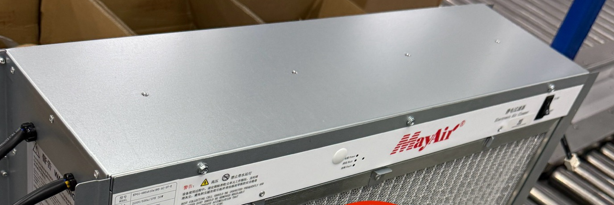
2.5 Physical Photos of Electrostatic Filter
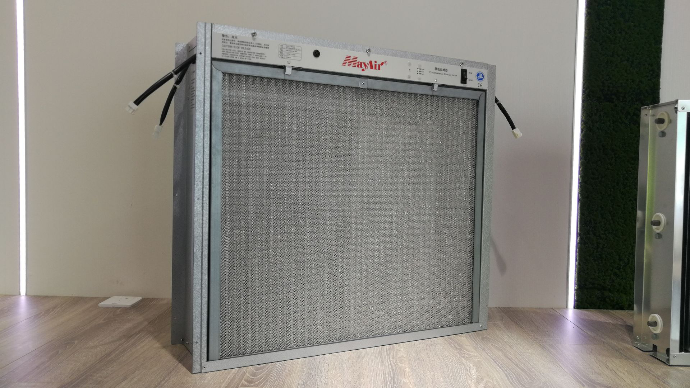
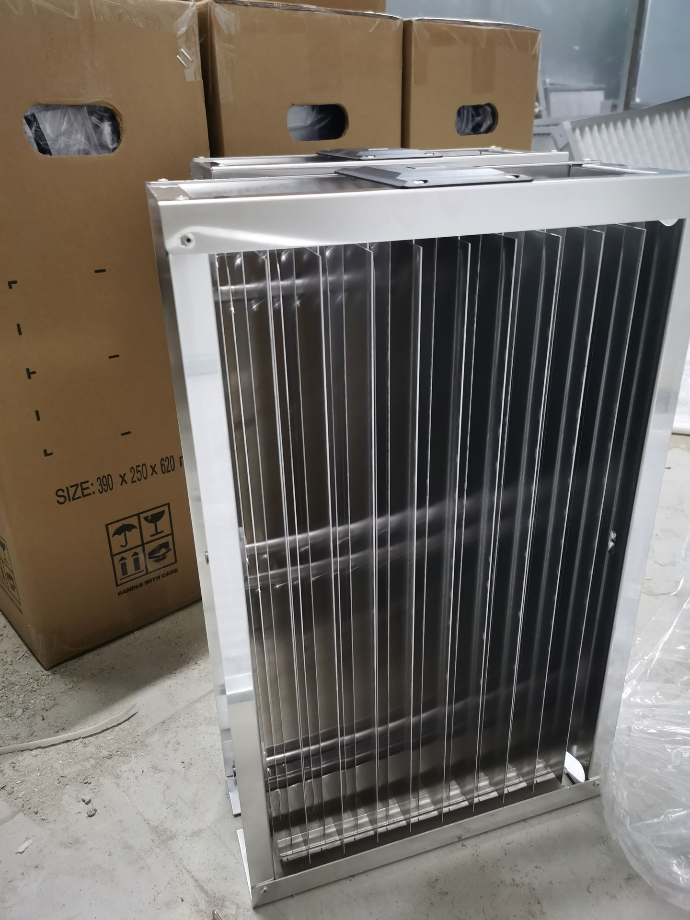
Appearance of Electrostatic Filter Internal Ion Box
III. Working Principle
3.1 Overview of High-voltage Electrostatic Dust-removal Principle
The core of high-voltage electrostatic dust-removal technology lies in the dual effects of electric-field ionization and charged adsorption. Electrostatic dust-removal modules integrated into air conditioning systems mainly adopt a two-stage structure consisting of two core units: an ionization zone and a dust-collecting zone. When air-supply airflow carrying dust particles of the air conditioner passes through the dust-removal module, the high-voltage ionization zone generates a strong electric field to ionize air and produce large quantities of positive and negative ions. Suspended dust, particulates, lampblack particles and other contaminants in the airflow collide with ions and become charged. The charged particulates flow into the dust-collecting zone along with airflow. Under the electric field force of the dust-collecting electric field, charged particulates migrate directionally and are adsorbed onto the surfaces of positive and negative dust-collecting plates respectively, achieving thorough separation between dust and airflow. Purified clean airflow is delivered into indoor or production areas through air conditioning ducts. Adsorbed dust can be removed by regular cleaning of dust-collecting plates to restore dust-removal performance, with no filter consumables required.
High-voltage electrostatic dust-removal modules adapted for air conditioning systems adopt an optimized design of low-voltage ionization and high-voltage adsorption with controllable electric field intensity, which effectively avoids excessive ozone generation. Featuring compact size and modular structure, they can be easily embedded into air handling units, air ducts, return air outlets and other positions, suitable for both renovation and new installation projects of various air conditioning systems.
3.2 Installation Examples of Electrostatic Filters
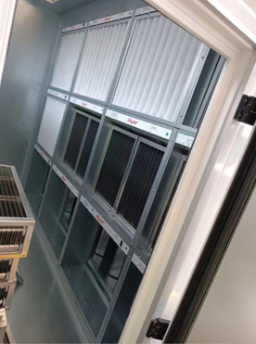
IV. Core Advantages of High-voltage Electrostatic Dust-removal Products
Combined with operating conditions of air conditioning systems, high-voltage electrostatic dust-removal technology presents four core advantages. First, high purification efficiency and wide particle size adaptability. The purification rate for large dust particles above 10 μm is close to 100 %, and the purification efficiency for fine particulates of 0.1-2.5 μm can reach over 85 %, making up for the deficiency of traditional air conditioning filters in fine-dust purification. Second, low operating air resistance and remarkable energy-saving effect. The permeable module structure has no dense filter layer; its operating air resistance is only 1/3-1/2 of that of traditional medium efficiency filters, which effectively reduces the operating load of air conditioning fans and cuts system energy consumption. Third, consumable free and reusable with low operation maintenance costs. It eliminates one-off filter consumables and only requires regular water washing maintenance, greatly lowering long-term operation maintenance expenses and solid waste emissions. Fourth, strong modular adaptability. It can be flexibly embedded into various air conditioning equipment such as combined air handling units, fresh air air conditioners, fan coil units and air duct air supply systems to meet operating demands under different air volumes and working conditions.
V. Application of High-voltage Electrostatic Dust Removal in Air conditioning Systems for Different Premises
5.1 Living Environments in Commercial Buildings
Public buildings such as large shopping malls, office buildings, metro stations, airports and hotels generally adopt centralized central air conditioning systems, characterized by dense occupancy, large fresh air demand, frequent air circulation and complex indoor dust sources. Dust mainly comes from outdoor dust brought in by fresh air and suspended particles generated by human activities. Traditional central air conditioners are only equipped with primary efficiency filters with weak capacity for fine particulate purification. Long-term operation easily causes duct dust accumulation, deterioration of indoor air quality and respiratory discomfort among occupants.
In central air conditioning systems of public buildings, high-voltage electrostatic dust-removal modules are mainly embedded in the air supply section, return air outlets or fresh air ducts of air handling units in modular form to realize circulating purification for all air systems. For large space premises such as open plan office areas and large shopping malls, the low air resistance property of electrostatic dust-removal modules ensures high air volume and low energy consumption operation of central air conditioners, prevents decline in cooling and heating efficiency caused by filter clogging, continuously reduces indoor PM2.5 and suspended dust concentrations, and improves comfort in public spaces.
5.2 Station Hall Environments of Public Transport Hubs and Airports
In air conditioning systems of transport hubs such as metro stations and airports, large passenger flow and strong interference from outdoor air pollution lead to sharp fluctuations in airborne particulate concentrations. Fresh air conditioning systems equipped with two stage high-voltage electrostatic dust-removal units deliver 1.3-1.5 times the purification performance of traditional filter type air handling units. They effectively stabilize indoor air quality and provide a healthy ventilation environment for passengers, while greatly reducing operation maintenance frequency of central air conditioners to satisfy demands for long-term continuous operation of public buildings. For commercial scenarios such as hotels and small shops, return air outlet type electrostatic dust-removal modules can be adopted. Without modification to main air conditioning structures, they feature easy installation and space saving performance, and can effectively adsorb indoor dust and slight lampblack particles to optimize indoor air conditions.
5.3 Residential Environments
Purification demands for residential air conditioning systems focus on treatment of low concentration fine dust and haze particles, with high requirements for equipment noise reduction, energy saving performance and safety. With the popularization of household fresh air air conditioners and wall mounted fresh air systems, miniaturized high-voltage electrostatic dust-removal modules have been widely applied in residential air conditioning systems for residential areas suffering frequent haze and heavy dust.
5.4 For the above mentioned purification scenarios, high-voltage electrostatic dust-removal products can be considered.
Leveraging the advantages of large air volume and low air resistance of electrostatic dust removal, they improve the air purification capacity of air conditioning systems for ultra fine particles and harmful gases to satisfy scenario specific requirements.
VI. Reference Cases Based on the Company’s Existing Products
Demonstration Example Net installation frame dimension of air handling unit: W=1400 mm, H=1050 mm Standard electrostatic filters: EP-370610180-AC-ST, EP-680610180-AC-ST
6.1 Horizontal-width Layout Application
Total width W of electrostatic modules = (2*681) − {(2−1)*14}=1348 mm Total width W of electrostatic modules =1348 mm, which is less than the net installation frame width W=1400 mm of the air handling unit. Width of sealing sheet metal on left and right sides = {(net inner cross section width 1400 mm of airhandling unit − total width 1348 mm of electrostatic filter) ÷2}+20=46 mm
6.2 Vertical-height Layout Application
Total height H of electrostatic filters = (6101 layer)+(3701 layer (horizontal-mounted electrostatic filter))=980 mm Bottom: base height of 20 mm is configured. Remaining top height: dimension of top sealing steel plate = (1050−980−20)+15=65 mm
6.3 Relevant Details
6.3.1 For side-by-side arrangement of electrostatic modules, reserved holes shall be uniformly arranged along flange edges of side frames, and self-tapping screws shall be adopted for connection and fixation.
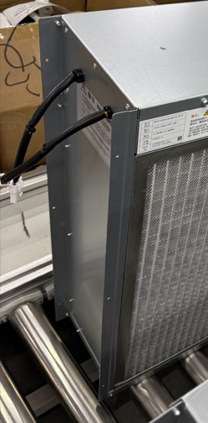
6.3.2 Flange edges of side frames For stackedheight arrangement of electrostatic modules, reserved holes shall be uniformly adopted with selftapping screws for connection and fixation. Reserved mounting holes on the top
VII. Common Functions of Electrostatic Filters
7.1 Air flow Sensing Component
Air operated switch (also known as air flow sensor or air flow sensing switch) is a sensor that detects air flow / wind speed and outputs on-off electric signals. It is mainly used to judge whether the fan runs normally and whether air flow exists inside air ducts to realize linked start stop of equipment. Factory set trigger wind speed for air flow sensing: 0.5 m/s. The purifier will be activated when wind speed exceeds this value. Operating temperature range: −40 ℃ ~ +65 ℃. Schematic Physical Photo of Air operated Switch
7.2 Signal Output
Passive dry contact signal: it carries no power supply itself and consists of a pair of mechanical on-off terminals. Common feedback signal types of electrostatic filters: operating signal, fault signal and cleaning signal. Main characteristics: excellent electrical isolation and strong anti-interference performance against external disturbance.
VIII. Conclusion
Boasting core advantages of high efficiency, low resistance, consumable-free operation and strong adaptability, high-voltage electrostatic dust-removal technology can be widely applied in various air conditioning and fresh air systems. It effectively makes up for technical defects of traditional filter type air conditioning dust-removal systems, and delivers remarkable effects in improving indoor air cleanliness, reducing air conditioning operating energy consumption, cutting operation maintenance costs and mitigating solid waste pollution. Featuring high-efficiency purification, low energy consumption and zero pollution, high-voltage electrostatic dust-removal air conditioning systems are widely used in green buildings, healthy living environments and other fields, providing technical support for indoor air quality improvement and air conditioning system optimization.