
Abstract
By comparing mainstream pollutant control technologies applied in the catering fume electrostatic precipitator industry and combining the pollutant characteristics of the catering sector, a complete cooking Fume electrostatic precipitator system is developed in this paper. The fume electrostatic precipitator is designed to eliminate liquid oil droplets and solid particulate matter contained in cooking fume, while the deodorizing filter targets gaseous pollutants within fume. A UV photolysis oxidation module and an activated carbon adsorption module for fume treatment are developed based on the principles of photolytic oxidation and filtration. Furthermore, tests are conducted to compare the airflow resistance and non-methane hydrocarbon (NMHC) removal efficiency of six types of deodorizing filters under identical air volume conditions.
1.Introduction of cooking fume electrostatic precipitator
Driven by rapid social development, people’s material demands have been fully satisfied, giving rise to pursuit of higher-quality life experiences, especially diverse cuisines. This trend has greatly boosted the expansion of the catering industry. Catering establishments cover independently operated restaurants, food service outlets inside hotels and guesthouses, staff canteens for centralized dining, central kitchens and other collective food processing facilities. In densely populated metropolises, commercial restaurants are densely distributed in business districts and residential communities. Western cuisine adopts relatively simple cooking techniques, whereas Chinese cooking features complicated operations such as stir-frying, braising, deep-frying and grilling. Pollutants generated during cooking are mostly suspended over urban areas for a long time after emission, posing a direct threat to residents’ physical health.
In addition, rapid urbanization has led to a growing number of street-side catering stores. Fast cooking methods including deep-frying and barbecue are increasingly popular among young consumers, and these catering activities produce far higher concentrations of cooking fume. Statistics indicate that barbecue generates 3 to 10 times more gaseous pollutants than Western-style cooking. Cooking fume contains massive inhalable particulate matter as well as various volatile organic compounds (VOCs). Long-term exposure to high-concentration cooking fume raises the risk of respiratory diseases and impairs human health. Accordingly, developing efficient and practical purification solutions for cooking fume electrostatic precipitators has become an urgent task to be addressed at present [1,2].
2.Pollutant Characteristics of the Catering Industry
Catering waste gas mainly consists of three components: liquid oil droplets, solid particulate matter and gaseous pollutants [3]. Liquid oil droplets and solid particles generally have particle sizes below 10 μm, among which PM2.5 accounts for over 80% of PM10, making catering fume a critical source of atmospheric PM2.5 emissions. Gaseous pollutants are dominated by volatile organic compounds (VOCs). Relevant research has identified more than 300 organic compounds detectable in catering exhaust gas. Non-methane hydrocarbons (NMHCs) are adopted as a core indicator to quantify gaseous VOC pollutants from catering exhaust.
Definition of VOCs
Under the standard atmospheric pressure of 101.3 kPa, VOCs refer to all organic compounds with a boiling point lower than 250 °C, or organic compounds whose saturated vapor pressure exceeds 133.32 Pa at room temperature (25 °C) and are discharged into the atmosphere in gaseous molecular form.
Definition of NMHCs
In accordance with HJ 38-2017 Stationary Source Emission-Determination of Total Hydrocarbons, Methane and Non-Methane Hydrocarbons-Gas Chromatography Method, NMHCs represent the total amount of gaseous organic compounds that produce responses on the flame ionization detector (FID) of a gas chromatograph, minus methane content.
GB 18483-2001 Emission Standard of Cooking Fume for Catering Industry specifies the NMHC emission concentrations of typical catering outlets. Measured NMHC concentrations from catering facilities range from 0.27 mg/m³ to 100.11 mg/m³, with an average value of 9.98 mg/m³ (approximately 10.0 mg/m³). If the NMHC emission limit is set at 10.0 mg/m³, 73.1% of catering operators can meet the discharge standard.
3.Pollutant Control Technologies for Catering Fume
Common purification technologies for cooking fume exhaust include mechanical separation, high-voltage electrostatic precipitation, filtration, liquid scrubbing, photolytic oxidation, biodegradation and plasma treatment.
High-voltage electrostatic precipitation, filtration, liquid scrubbing and biodegradation deliver outstanding removal performance for particulate fume: high-voltage electrostatic precipitation and liquid scrubbing achieve particulate removal efficiency above 90%, while filtration reaches 80%–90%. Biodegradation is highly sensitive to ambient temperature, with a particulate removal efficiency of 60%–85%. For VOC elimination, photolytic oxidation, biodegradation and plasma treatment show superior performance: photolytic oxidation and biodegradation both attain 60%–90% VOC removal efficiency, and plasma technology removes over 95% of VOCs. To simultaneously remove particulate fume and VOCs effectively, this paper proposes a combined process integrating high-voltage electrostatic precipitation, photolytic oxidation and filtration.
3.1 High-Voltage Electrostatic Precipitation
Also known as electrostatic deposition, this technology generates an electrostatic field strong enough to ionize gas under high-voltage direct current. As cooking fume passes through the electric field, particulate fume is ionized and charged, then migrates toward oppositely charged collecting plates and adheres to the plate surface to form an oil particle layer, thereby realizing fume electrostatic precipitator. Meanwhile, ozone is produced via air ionization in the electric field, which provides auxiliary purification of VOCs.
3.2 Photolytic Oxidation
Ultraviolet (UV) light refers to electromagnetic waves with wavelengths ranging from 100 nm to 400 nm. UV light at 185 nm is primarily used for organic matter decomposition. The photolytic oxidation method for cooking fume employs dedicated UV lamps emitting 185 nm UV radiation to break long-chain grease molecules into small molecular fragments. Meanwhile, the UV light reacts with oxygen in air to generate ozone, which further oxidizes fragmented grease molecules into water, carbon dioxide and trace white powder, and partially eliminates unpleasant odors from cooking fume.
3.3 Filtration Technology
Filtration is categorized into conventional physical filtration and adsorptive filtration. Adsorptive filtration uses activated carbon or other adsorbents to control fume odor, and must be combined with other purification devices.
Activated carbon features a large specific surface area and stable chemical properties, making it a widely adopted adsorbent medium. It removes organic waste gas mainly through physical adsorption, relying on abundant pore structures with micropores smaller than 2 nm to trap most VOC molecules. In addition, functional groups including carboxyl, hydroxyl, phenolic, lactonic, quinonic and ether groups are loaded on activated carbon surfaces, enabling chemical reactions with partially adsorbed organic molecules.
4.Design of the Cooking Fume Electrostatic Precipitator System
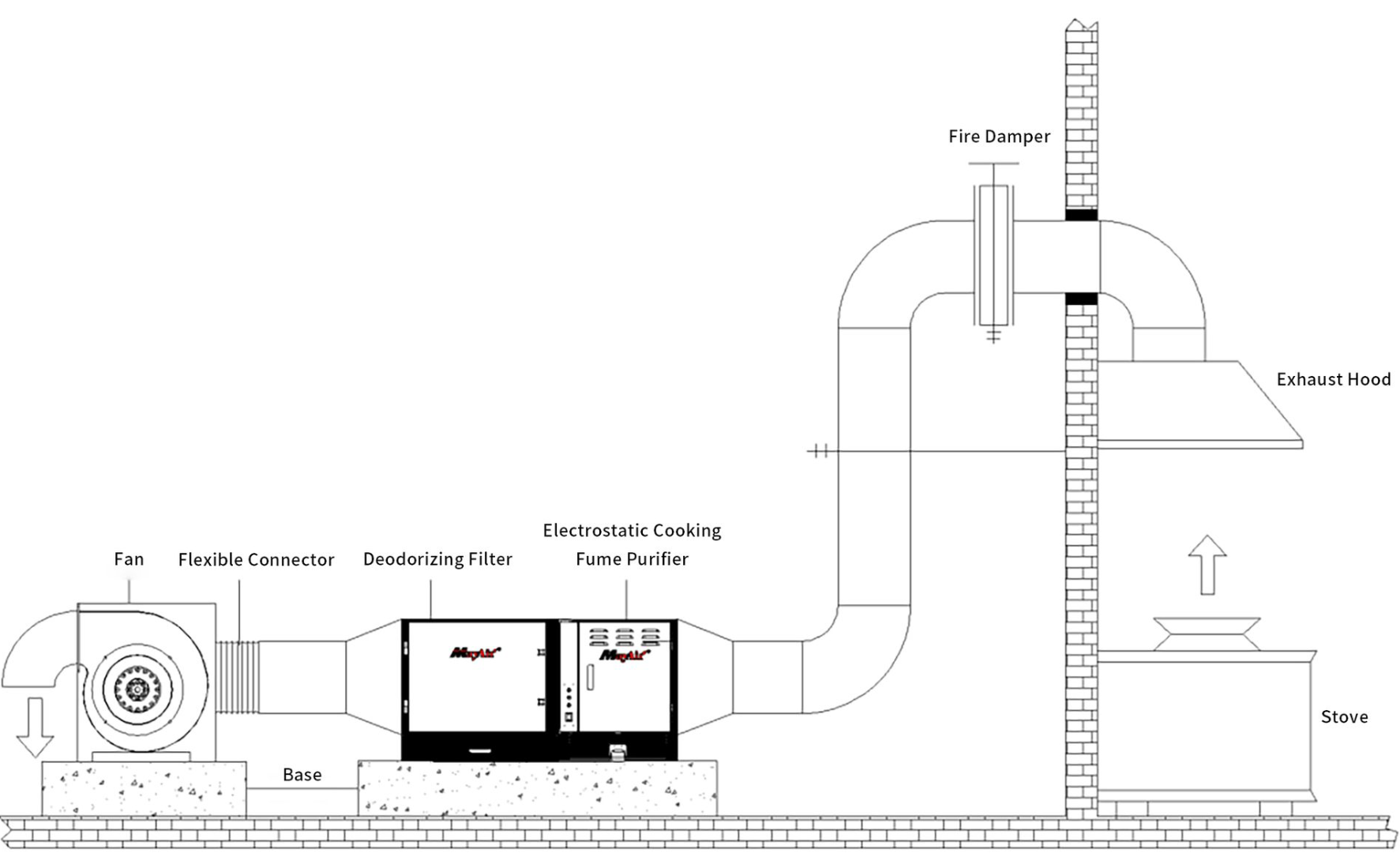
The layout of the cooking Fume electrostatic precipitator system is illustrated in Figure
1. The system comprises an exhaust hood, exhaust duct, fire damper, primary fume electrostatic precipitator, deodorizing filter and induced draft fan. The terminal fan acts as the power unit, generating negative pressure to draw cooking fume generated on stoves through the exhaust hood into the duct. The primary fume electrostatic precipitator removes solid particulate matter and liquid oil droplets from fume, while the deodorizing filter eliminates VOCs.
4.1 Primary Fume Electrostatic Precipitator
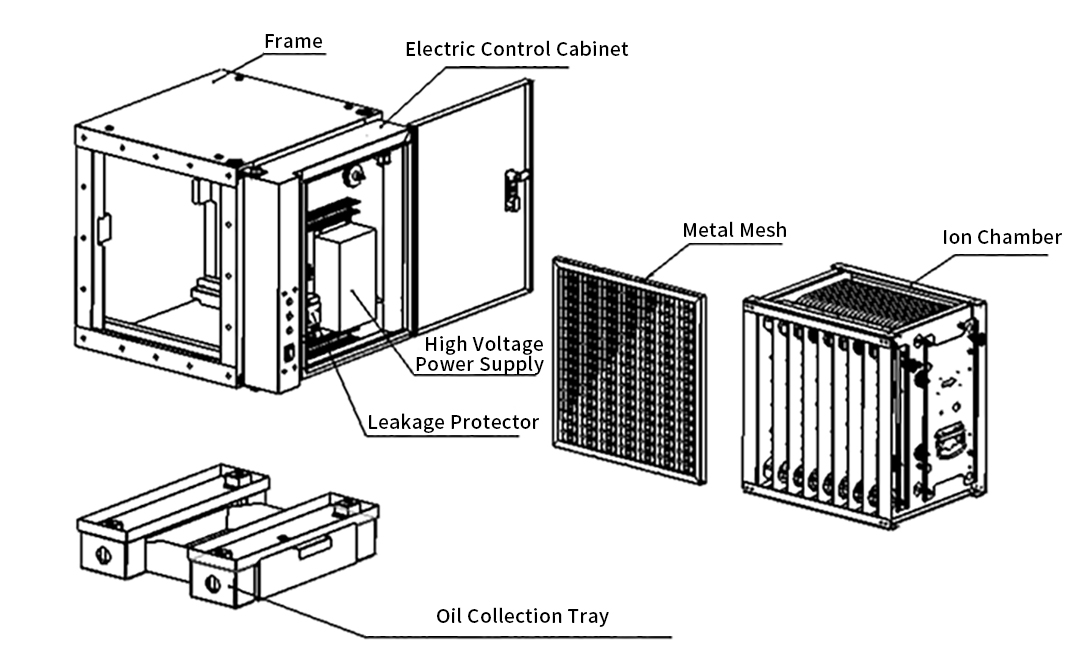
The structural layout of the primary fume electrostatic precipitator is shown in Figure 2. When cooking fume flows through the equipment, large oil droplets and mist particles are intercepted by metal mesh screens. Fine oil mist particles are charged in the high-voltage electric field and adsorbed onto integrated collecting plates, then coalesce and drip into the oil collection tray at the bottom of the unit to separate solid and liquid fume particles. Under rated air volume, the one-pass PM2.5 filtration efficiency exceeds 90%. Ozone generated during ionization in the high-voltage electric field also provides auxiliary removal of VOCs in cooking fume.
Structural Diagram of Primary Cooking Fume Electrostatic Precipitator
4.2 Deodorizing Filter
Two types of deodorizing filters are commonly equipped in cooking fume electrostatic precipitator systems based on distinct purification mechanisms: UV photolysis fume treatment modules and activated carbon adsorption modules.
(1) UV Photolysis Fume Treatment Module
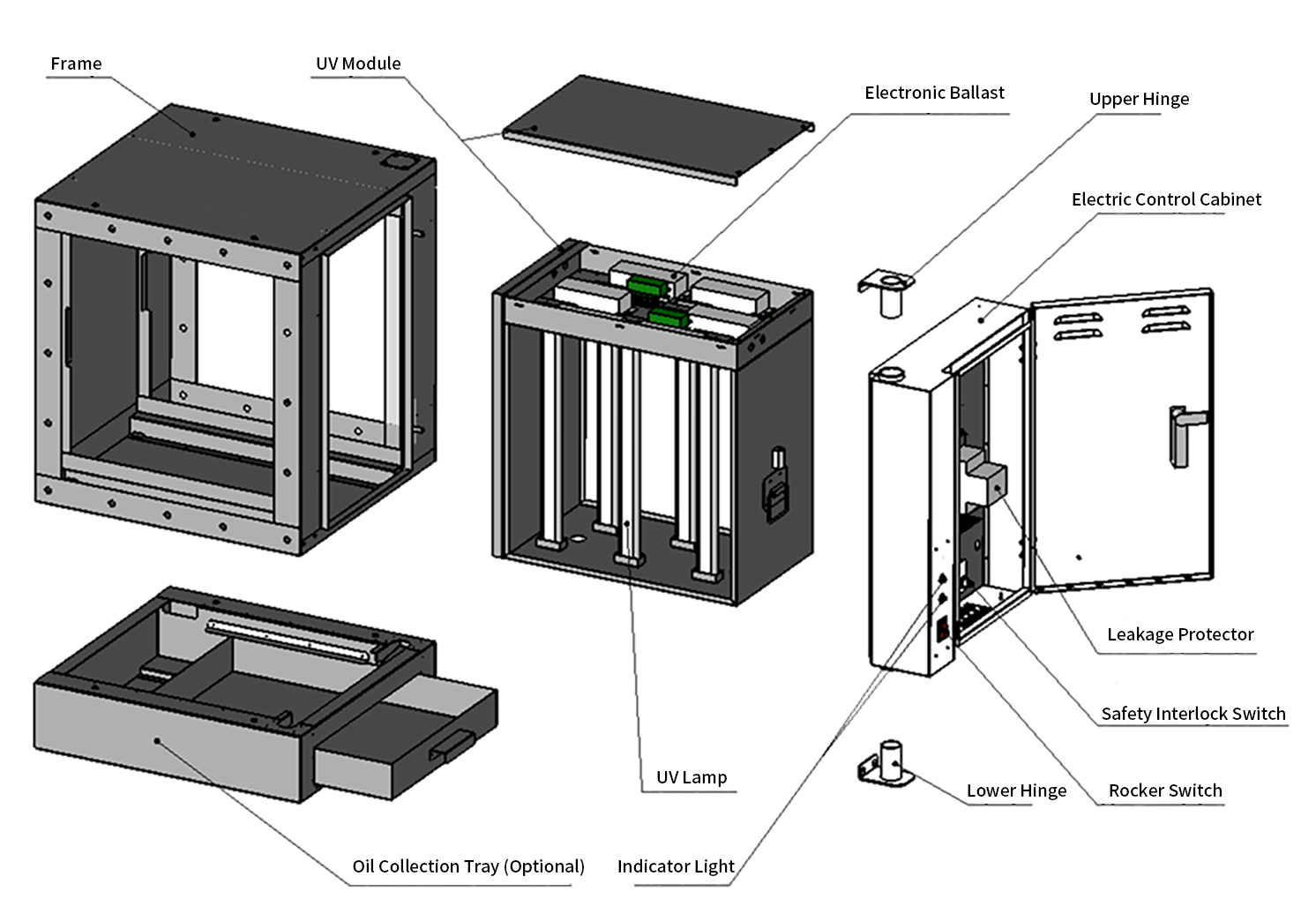
The structure of the UV photolysis module is displayed in Figure 3. The core UV lamps can be configured with different quantities according to actual treatment demands.
Advantages of this module include low upfront investment, low airflow resistance, low power consumption and a service life of up to 8,000 hours for UV lamps.
Structural Diagram of UV Photolysis Cooking Fume Module
(2) Activated Carbon Adsorption Module
As shown in Figure 4, the activated carbon module has four structural types: flat panel, U-type, V-type and carbon cylinder. The flat panel structure is filled with honeycomb activated carbon blocks; U-type and V-type modules adopt flaky granular coconut shell carbon; carbon cylinders are packed with columnar coal-based activated carbon. For activated carbon modules, larger filtration area of the carbon bed corresponds to lower filtration velocity, which reduces overall equipment resistance, extends the residence time of cooking fume and improves VOC removal efficiency.
In practical operation, the removal effect of NMHCs improves with lower system air volume when treating fume of identical concentration. The underlying reason is that VOCs require sufficient contact time (typically more than 2 seconds) with UV radiation for complete decomposition. Excessively high airflow velocity inside ducts leads to low measured NMHC removal efficiency, i.e., poor VOC purification performance. To enhance VOC elimination, operators can increase duct diameter, reduce airflow velocity inside pipelines or install additional UV lamps within photolysis modules.
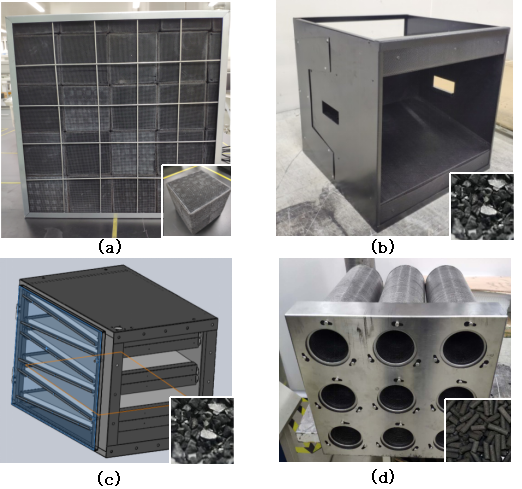
(a) Flat panel type filled with honeycomb activated carbon blocks;
(b) U-type filled with flaky granular coconut shell carbon;
(c) V-type filled with flaky granular coconut shell carbon;
(d) Columnar coal-based activated carbon.
5.Conclusions
A UV photolysis module and an activated carbon adsorption module for cooking fume treatment are designed based on photolytic oxidation and filtration principles. Comparative tests of different module configurations are carried out to measure airflow resistance and NMHC removal efficiency under identical air volume. Test results demonstrate that the activated carbon module achieves higher NMHC removal efficiency from cooking fume than the UV photolysis module. However, VOC-saturated activated carbon is classified as hazardous waste, resulting in high costs for post-operation disposal and maintenance.
UV photolysis modules deliver better cost performance for small-scale catering businesses. For large catering enterprises, the application of recyclable adsorption-catalytic oxidation equipment represents a new research direction and challenge for VOC governance across the catering industry.