
If you are an overseas operator looking to expand your catering footprint, China is undeniably a worthwhile market to consider. Boasting an inclusive and diverse food culture, Chinese consumers readily embrace cuisines from all over the world. With your signature flavors, you can easily build a loyal customer base.
Nevertheless, after traveling across oceans to complete preliminary preparations and start site selection, there is one critical matter you must clarify well in advance: every region in China enforces clear regulatory requirements governing cooking fume emissions from the catering sector.
Many foreign entrepreneurs may wonder: Can cooking fumes not be discharged directly? The answer is no. Under China’s environmental protection regulations, all operating restaurants must install cooking fume electrostatic precipitators. Fumes can only be vented outdoors after being filtered by electrostatic precipitators to meet compliance standards, with stricter and more standardized oversight than many other countries. Fully understanding these rules beforehand will save you countless detours when launching your restaurant smoothly.
A point that merits extra attention is China’s vast territory. Each province and municipality has formulated distinct local emission standards tailored to regional environmental carrying capacities and local culinary characteristics. Some densely populated cities with stringent environmental requirements impose even tighter concentration limits than the national standard. Below is a breakdown of cooking fume emission control regulations across China’s regions.
I. National Standard
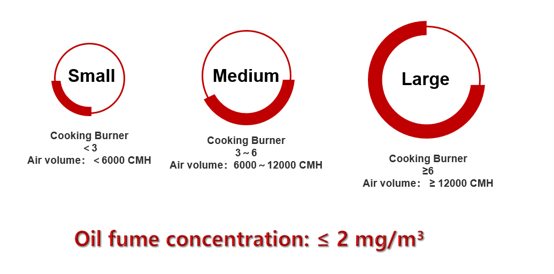
China’s national standard Emission Standard of Cooking Fume (GB18483-2001) was officially released in November 2001 by the former State Environmental Protection Administration and the former General Administration of Quality Supervision, Inspection and Quarantine. It clearly defines key terminology including cooking fume, catering establishments, unorganized emissions, and cooking fume removal efficiency. Catering facilities are classified into three sizes based on stove quantity and air volume:
· Small-scale catering: 1–3 stoves, air volume ≤ 6,000 m³/h
· Medium-scale catering: 3–6 stoves, air volume 6,000–12,000 m³/h
· Large-scale catering: ≥ 6 stoves, air volume > 12,000 m³/h
Per the standard, regardless of business size, the outlet concentration of cooking fumes after purification by electrostatic precipitators must not exceed 2 mg/m³. The national standard also stipulates minimum purification efficiency thresholds for each tier: 60% for small establishments, 75% for medium ones, and 85% for large ones. However, purification efficiency is heavily affected by upstream operating conditions and cannot serve as the sole criterion for compliance. For example, if a small restaurant generates raw fumes at an initial concentration of 6 mg/m³ and only uses a electrostatic precipitator meeting the minimum 60% efficiency requirement, the treated outlet concentration will reach 2.4 mg/m³, failing the concentration limit.
In practical project inspections, the measured fume concentration at the exhaust outlet is adopted as the core acceptance indicator, rather than the nominal purification efficiency labeled on electrostatic precipitators. Therefore, learning about the fume generation traits of your cuisine type and the actual raw fume concentration in advance allows you to select a properly sized electrostatic precipitators to achieve compliant emissions.
II. Shandong Provincial Local Standard
Shandong’s ecological and environmental authorities responded to the national standard at an early stage in 2006 and issued the provincial standard Emission Standard of Cooking Fume (DB37/597-2006), formulated to match local catering industry characteristics. Compared with national requirements, this local standard tightens outlet fume concentration limits differentially by business scale: 1 mg/m³ for large catering outlets, 1.2 mg/m³ for medium ones, and 1.5 mg/m³ for small ones.
Given small catering businesses generally feature high mobility, low total fume output and modest operation scale, regulators adopted a balanced approach: moderately relaxed limits for small venues while imposing far stricter controls on large establishments, fully embodying region-specific governance.
Additionally, this provincial standard introduced a new mandatory control indicator for the first time: odor concentration ≤ 70 (dimensionless). While fume concentration limits address visible smoke pollution, odor concentration thresholds target persistent nuisance odors that disturb nearby residents. This provision means traditional single-principle fume purification electrostatic precipitators no longer satisfy local compliance demands. Multi-principle composite purification technology is mandatory to fundamentally eliminate both fume particulates and offensive odors for stable, compliant discharge.
III. Shanghai Municipal Local Standard
Shanghai’s local standard Emission Standard for Catering Fume (DB31/844-2014) follows a streamlined regulatory framework without tiered size classifications. It mandates a universal fume emission concentration cap of ≤ 1 mg/m³ for all catering businesses, imposing stricter overall limits than the national standard.
For odor control, the standard sets conditional requirements only: if catering fumes impact environmentally sensitive surrounding areas, operators must deploy effective deodorization systems to ensure odor concentration does not exceed 60 (dimensionless). Odor regulation avoids blanket enforcement and is only implemented when odor complaints or verifiable environmental impacts arise.
Both Shandong and Shanghai’s local standards specify dimensionless odor concentration limits. The term “dimensionless” refers to unitless numerical values. Testing follows the national standard Three-Point Comparison Odor Bag Method, in which professional odor panelists gradually dilute collected odor samples with clean air for sensory assessment; the resulting dilution multiple is the dimensionless odor concentration reading.
Due to natural variations in individual olfactory sensitivity, odor concentration thresholds serve only as regulatory references. Law enforcement frequently encounters scenarios where measured odor levels remain within limits yet local residents still file odor nuisance complaints, representing a core dilemma in current fume odor governance. To resolve this challenge, catering operators must select high-adaptability fume electrostatic precipitators paired with dedicated deodorization technologies to curb odor generation at the source.
IV. Beijing Municipal Local Standard
Beijing rolled out its local atmospheric pollutant emission standard for the catering sector in 2017, formally published as Emission Standard of Air Pollutants for Catering Industry (DB11/1488-2018). Extensive empirical research underpinned groundbreaking regulatory upgrades. While retaining fume concentration limits, the standard introduced two additional control indicators: non-methane hydrocarbons (NMHC) and particulate matter concentration. Uniform emission caps apply to all catering enterprises as follows:
· Maximum allowable cooking fume concentration: 1 mg/m³
· Maximum allowable particulate matter concentration: 5 mg/m³
· Maximum allowable non-methane hydrocarbon (NMHC) concentration: 10 mg/m³
Traditional on-site fume sampling yields inconsistent test results due to sampling methodologies and real-time concentration fluctuations. Since cooking fumes primarily consist of fine particulates, the newly added particulate matter index acts as a supplementary verification metric to improve compliance judgment accuracy. Furthermore, to mitigate subjectivity in odor assessment, NMHC is incorporated as a quantifiable indicator for odor pollution, enabling more scientific and rigorous oversight logic. Catering operators must deploy electrostatic precipitators capable of simultaneously treating fume particulates and NMHC to satisfy the multi-dimensional emission requirements of this standard.
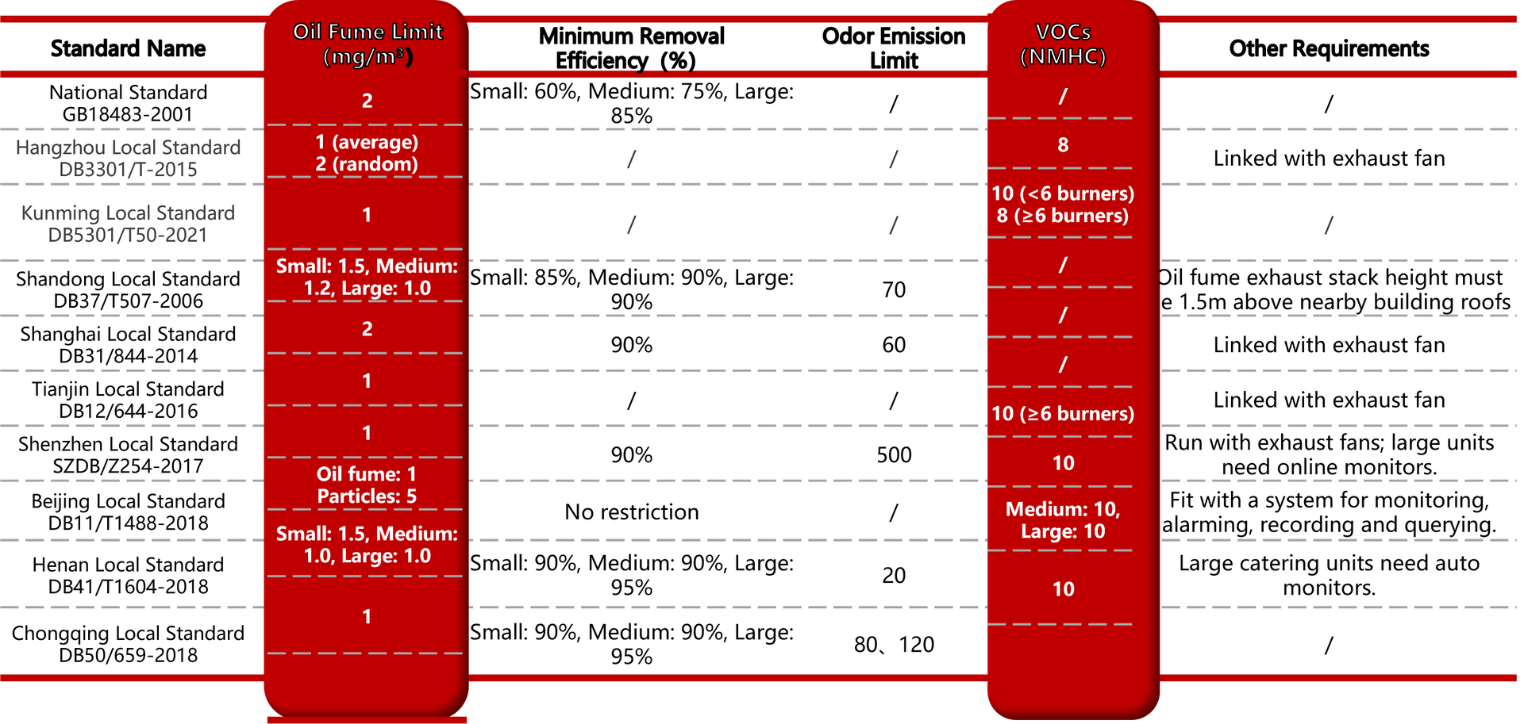
Many other Chinese cities including Chongqing, Hangzhou, Tianjin, Shenzhen and Kunming have rolled out customized local cooking fume emission standards aligned with their regional atmospheric governance priorities. Most regional codes cover two core indicators: cooking fume concentration and NMHC concentration, while several cities add separate odor concentration control provisions for more granular pollution management. Operators must select electrostatic precipitators that handle fume particulates and NMHC simultaneously, with deodorization functionality required in some jurisdictions, to meet multi-faceted emission control rules. A summary table of regional emission limits is provided for reference below.
Summary Table of National and Local Cooking Fume Emission Limits
With this overview, you now possess a comprehensive understanding of cooking fume emission compliance requirements in China. All enterprises interested in expanding their catering operations in China are warmly welcomed!