
With the official implementation of the Ecological Environment Code of the People's Republic of China on August 15, 2026, the Air Pollution Prevention and Control Law of the People's Republic of China is repealed simultaneously. Original provisions governing catering fume have been compiled and revised for incorporation into the Code. This article compares old and new legal provisions, sorts out the inheritance and changes in catering fume control. Combined with practical experience in catering fume purification engineering, it conducts analysis from dimensions including site selection control, dedicated flue construction, purification equipment selection and operation maintenance, and retrofitting of existing projects. It provides technical references for catering project design, electrostatic precipitator ESP selection, onsite operation maintenance and industry supervision.
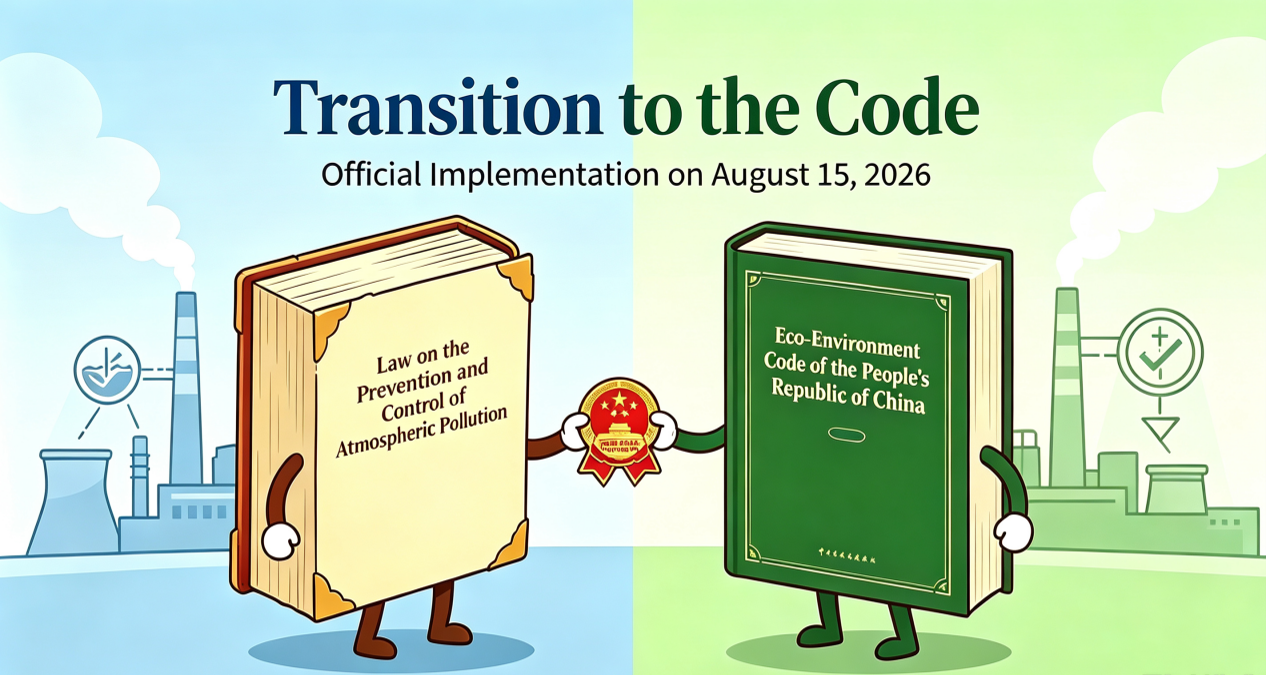
Recently, numerous selfmedia articles have reposted and interpreted the cateringfumerelated regulatory clauses in the Ecological Environment Code of the People's Republic of China. Nevertheless, many fail to conduct detailed comparison between old and new legal provisions, and simply treat all provisions of the Code as newlyissued regulatory rules. Some online accounts even use eyecatching headlines such as “Attention for the Catering Industry: The Code Bans Restaurants on Residential Building Floors” and “Stricter Control Under the Code: Where Will Catering Operators Go?”, which onesidedly exaggerate regulatory stringency and are somewhat misleading. In fact, core prohibitive requirements and electrostatic precipitator ESP obligations for catering fume control are mostly inherited from previous laws. The Code mainly integrates and partially optimizes the existing regulatory system.
I. The Ecological Environment Code of the People's Republic of China vs. the Air Pollution Prevention and Control Law of the People's Republic of China
The Ecological Environment Code of the People's Republic of China is compiled by integrating multiple separate laws, while the former Air Pollution Prevention and Control Law of the People's Republic of China was a separate law in the ecologicalenvironmental field. For catering fume control, the prohibitive and obligatory provisions under the old law were stipulated in Article 81, with corresponding administrative penalty provisions in Article 118. Under the Ecological Environment Code of the People's Republic of China, regulatory obligations and prohibitive content are set forth in Article 250, with corresponding penalty provisions in Article 1132. The comparison is presented below.
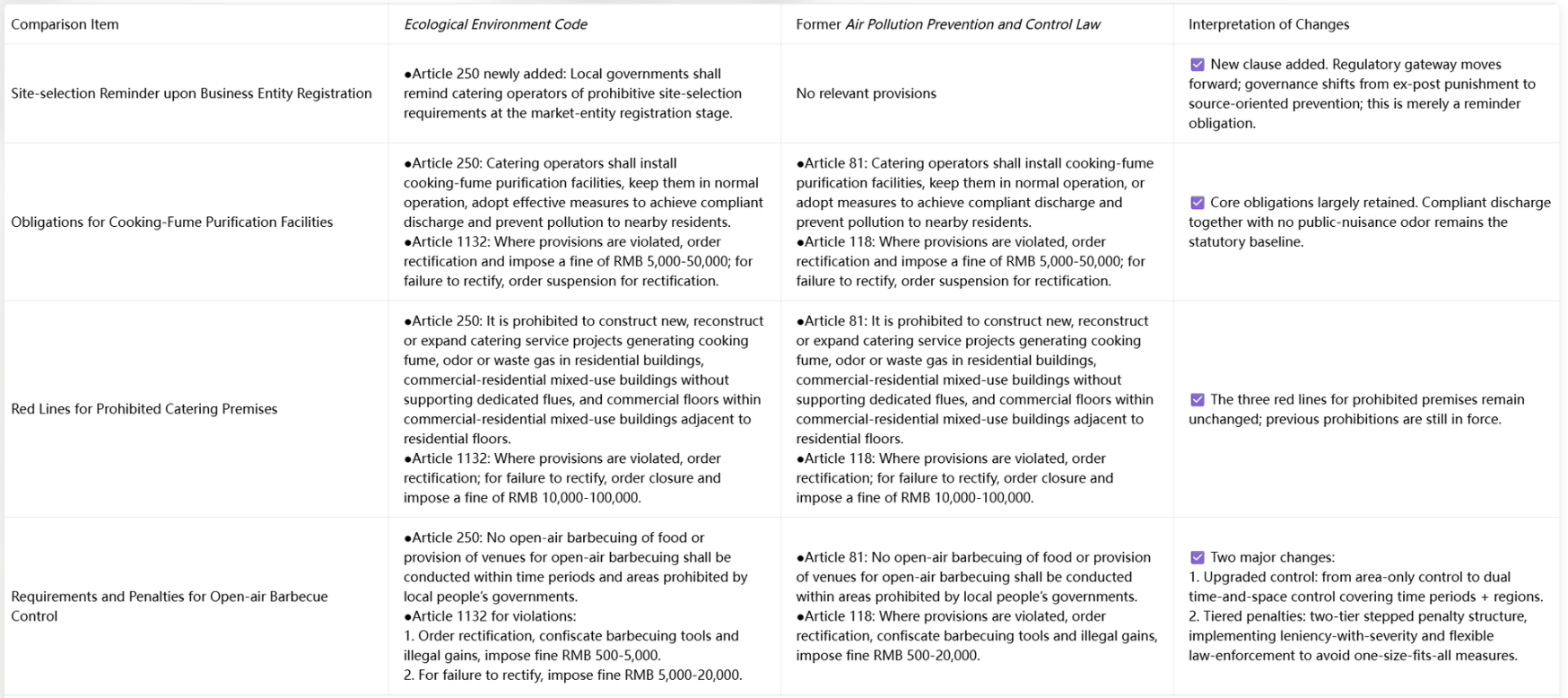
Comparison between old and new legal provisions shows that the Ecological Environment Code of the People's Republic of China incorporates mature systems for catering fume control from the former Air Pollution Prevention and Control Law of the People's Republic of China. Core obligations and penalty rules for catering operators, including installation of electrostatic precipitator ESPs and bans on cateringproject establishment in specific premises, are retained, and the industrywide compliance baseline remains unchanged.
1. Interpretation No.1 of Article 250
Article 250 newly stipulates that local governments shall remind catering operators of prohibitive site selection requirements at the market entity registration stage. This reflects the forward shift of regulatory focus under the Code: when catering operators go through formalities such as business license application, handling authorities are obligated to inform and remind them of relevant prohibitive site selection rules. The regulatory model shifts from expost punishment to sourceoriented prevention. This welldesigned institutional logic facilitates compliance in cateringproject siteselection from the source.
2. Interpretation No.2 of Article 250
Article 250 prohibits new construction, reconstruction and expansion of catering service projects generating fume, odors or waste gas in residential buildings, commercial residential mixed use buildings without supporting dedicated flues, and commercial floors within commercial residential mixed use buildings adjacent to residential floors. This provision is largely consistent with Article 81 of the former Air Pollution Prevention and Control Law of the People's Republic of China. The three siteselection red lines have remained in force for over a decade and must be strictly observed in the Code era.
Two common misinterpretations exist regarding this ban. First, it is easy to understand that cateringrelated projects are prohibited in residential buildings and commercialresidential mixeduse buildings without dedicated flues. However, for commercial floors within commercialresidential mixeduse buildings adjacent to residential floors, newconstruction, reconstruction and expansion of fumegenerating catering projects are still prohibited even if the building is equipped with public dedicated flues. Complete flue facilities cannot override this siteselection red line.
Second, the legal provision applies to clearlydefined targets: only newconstructed, reconstructed and expanded catering service projects that produce fume, odors or waste gas. On the one hand, existing catering business projects with legallyobtained formalities are not subject to this prohibitive clause and shall not be governed by this ban. On the other hand, catering business forms that do not generate fume, odors or waste gas fall outside the scope of this provision.
3. Interpretation No.3 of Article 250
Article 250 of the Ecological Environment Code of the People's Republic of China requires catering operators to install electrostatic precipitator ESPs and keep them in normal operation, and adopt effective measures to ensure fume discharge meets standards and prevent pollution to surrounding residents. This provision largely inherits the institutional spirit of Article 81 of the former Air Pollution Prevention and Control Law of the People's Republic of China, specifying four core requirements: installation of electrostatic precipitator ESPs, guaranteed normal operation of facilities, standard compliant fume discharge, and prevention of pollution caused public nuisance.
In other words, even if electrostatic precipitator ESP equipment is installed and kept in normal operation, pollutant discharge must meet standards and odor related public nuisance shall be avoided. This highlights practical difficulties in current catering fume governance: the industry generally prioritizes electrostatic precipitator ESP equipment installation over daily operation maintenance, and focuses on compliance monitoring data while ignoring sensory odor nuisance for residents. A real world contradiction exists between compliant pollutant monitoring results and residents’ sensory experience. Both quantitative emission indicators and actual sensory effects must be satisfied. This places higher performance requirements on products manufactured by electrostatic precipitator ESP producers, pushes for standardized design of catering smokeexhaust projects, and reminds catering operators to conduct proper maintenance of electrostatic precipitator ESPs and establish awareness of regular operationmaintenance. Longterm stable compliant discharge and effective avoidance of odor nuisance can only be achieved through highperformance electrostatic precipitator ESPs, scientifically compliant engineering design and sustained standardized operationmaintenance.
4. Interpretation No.4 of Article 250 and Article 1132
Article 250 of the Ecological Environment Code of the People's Republic of China prohibits openair barbecuing or providing venues for openair barbecuing within time periods and areas designated by governments as restricted or prohibited. Article 1132 sets two tiers of penalties: for initial violations, rectification shall be ordered, tools and illegal gains confiscated, and fines ranging from RMB 500 to 5,000 imposed; for failure to rectify, fines shall be increased to RMB 5,000 to 20,000.
Compared with the old law, the Code adds “prohibited time periods” to obligatory provisions to realize dual constraints of time and space. Meanwhile, it introduces a twotier stepped penalty system to reduce simplistic “onesizefitsall” law enforcement and realize flexible regulation. Under the old law, timeperiod restrictions were only stipulated in penalty provisions while behavioral obligations were limited to geographical constraints. The Code moves timerelated elements into obligatory clauses, aligning behavioral norms with corresponding legal penalties for more comprehensive legal basis.
II. Three Shifts in Governance Philosophy Under the New Code
First, compliance reminders are advanced to the business license application stage for merchants, transforming the previous governance model where penalties were imposed only after problems occur (Corresponding to: site selection reminders at market entity registration). Second, prohibited time periods are added for openair barbecuing. Instead of location only control, dual time and space constraints are implemented to adapt to real world urban governance demands (Corresponding to: added prohibited time periods for open air barbecuing). Third, stepped penalties distinguish initial violations from non-rectification, realizing lighter penalties for minor wrongs and heavier penalties for serious violations and avoiding simplistic “one size fits all” law enforcement (Corresponding to: two tier penalties for open air barbecuing).
For catering practitioners and the commercial kitchen engineering industry, the Code further highlights the logic that site selection prevails over governance. If a shop falls within a legallydefined prohibited area, it remains illegal even with fullyconfigured and highefficiency electrostatic precipitator ESPs. Therefore, prior to lease signing and engineering design, compliance verification of shop siteselection must be completed to avoid legal risks from the source.
⚠️ Special Reminder Full compliance in shop siteselection does not mean relaxation of fumepollution control. Catering operators are still legally required to install electrostatic precipitator ESPs, maintain their normal operation, and achieve stable standardcompliant fume discharge.
For catering outlets, reliable, highefficiency and highquality electrostatic precipitator ESPs are not merely tools for passing inspections. They serve as hardware foundations for resolving fumenuisance complaints, avoiding administrative penalties and sustaining longterm stable business operations. For cateringfume projects, attention shall be paid to electrostatic precipitator ESP equipment selection as well as subsequent operationmaintenance of electrostatic precipitator ESPs to achieve genuine longterm compliance.